
By Jarrod Gravison • Updated April 28, 2026 • 7 min read
⚡ Quick Answer
Stopping noise-triggered barking requires reducing exposure to triggers (white noise machine), building a positive association with triggers (counter-conditioning with treats), and training a reliable interrupt response (“look at me” or “quiet” cue). Punishment and extensive soothing both make reactive barking worse. Consistency over 2–4 weeks produces results.
Disclosure: This post contains affiliate links. We may earn a small commission at no extra cost to you.
Noise-triggered barking is one of the most common apartment dog behavior challenges. Here are 10 methods that work — applied consistently.
Key Takeaways
- White noise machines work immediately: Placing a white noise machine near your hallway wall is the single fastest fix for noise-triggered barking because it reduces your dog’s exposure to triggers before they ever reach his ears — no training required.
- Counter-conditioning beats punishment every time: According to the AKC, rewarding your dog with a high-value treat the moment a noise occurs changes the emotional response from alarm to calm anticipation. Punishment only amplifies anxiety and makes barking worse long-term.
- Exercise is the most overlooked solution: A physically and mentally tired dog has a significantly lower baseline arousal level. The ASPCA recommends 30–60 minutes of daily activity for most breeds — hitting that target can cut reactive barking incidents dramatically.
- Consistency over 2–4 weeks is non-negotiable: None of these methods work overnight. The nervous system needs repeated positive experiences to rewire. Commit to the full training cycle before evaluating whether a technique is working.
Environmental Management (Do These First)
1. White Noise Machine
Placed near the hallway-facing wall, a white noise machine masks acoustic triggers before they reach the dog’s ears. Immediately reduces trigger exposure. Low cost, high impact. See our dog anxiety guide.
2. Reposition the Dog’s Resting Area
A dog sleeping next to the front door will bark at every sound in the hallway. Moving the resting area to the interior of the apartment — a bedroom, an interior wall — reduces proximity to triggers significantly.
3. Block Visual Access
Window barking is visual-triggered; hallway barking is sound-triggered. For window barking: frosted window film or furniture arrangement that blocks the dog’s line of sight to the street reduces triggers dramatically.
When setting up your white noise machine, volume matters — it should be audible over normal hallway noise but not uncomfortably loud for human ears. The LectroFan Classic and similar models with non-looping fan sounds are preferred over those with simple wave recordings. Position matters too: floor level near the door amplifies masking effect because that’s where door-gap sound enters. In 2026, many apartment-focused pet owners are combining white noise with door draft stoppers to create a genuine acoustic barrier.
According to PetMD, dogs in apartments experience as many as 200 distinct auditory triggers per day — from elevator dings and neighbor footsteps to garbage chutes and hallway conversations. That level of stimulation without management keeps the sympathetic nervous system chronically activated, which is why reactive barkers in apartments seem to “never improve” despite training. Environmental management is the foundation; training builds on top of that foundation.
Training Methods
4. Counter-Conditioning
Every trigger sound = high-value treat, immediately. No waiting for silence — treat at the sound regardless of behavior. After 2–4 weeks, the emotional response shifts from alarm to anticipation. Maintain treat jar at the trigger location.
5. Teach “Quiet”
Wait for a natural pause in barking (dogs pause to breathe). Mark with “yes” and treat the silence immediately. Name it “quiet” after it’s reliable. See our how to teach quiet guide.
6. Teach “Place” or “Go to Bed”
A reliable “go to your bed” command sends the dog away from the trigger location (door, window) on cue. Takes 2–4 weeks to establish reliably but provides direct management of barking situations.
7. Focus Cue (“Look at Me”)
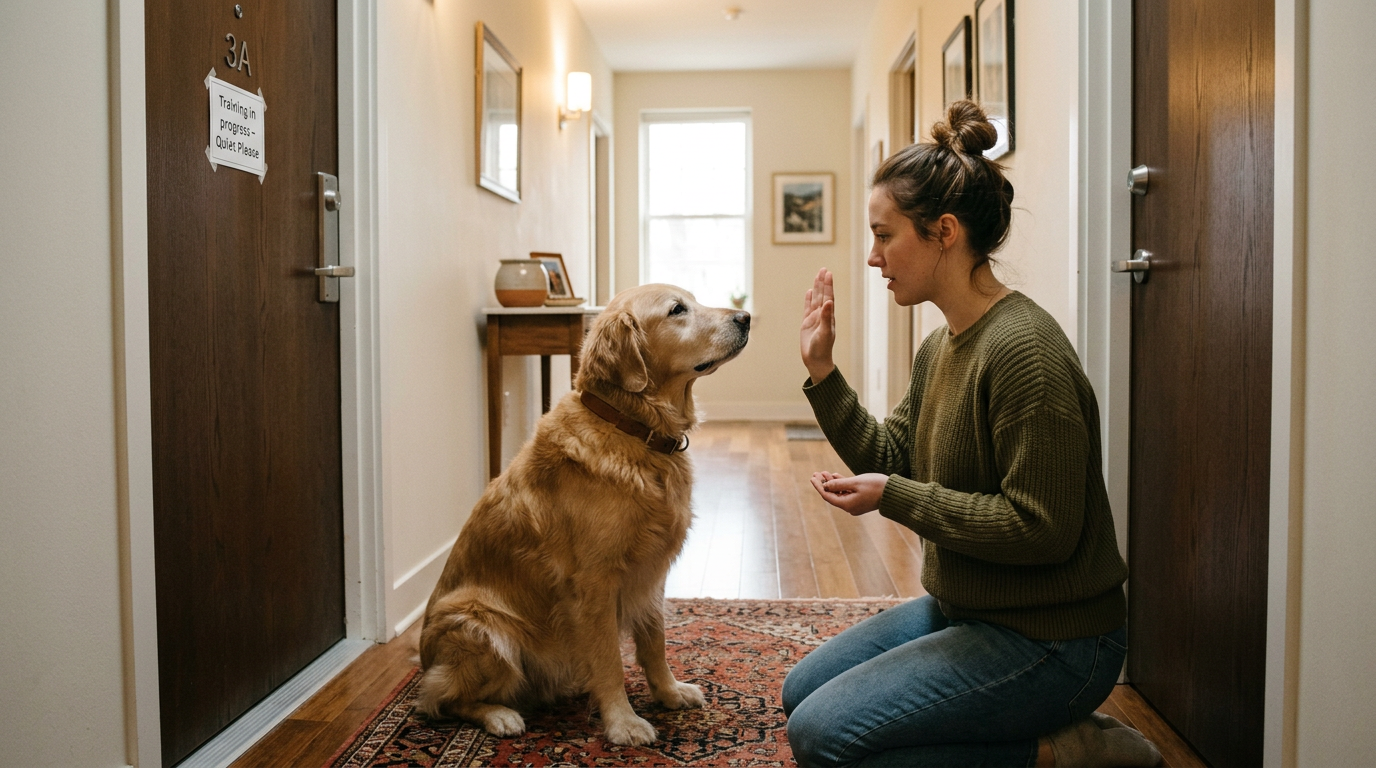
Practice daily: say “look,” mark and reward eye contact. Build to being able to use this cue the moment the dog hears a trigger and before they bark. Eye contact with you is incompatible with barking.
8. Desensitization
Record or find recordings of your dog’s specific triggers (elevator sounds, hallway footsteps). Play at very low volume while treating. Gradually increase volume over days and weeks as the dog stays calm. Systematic desensitization requires patience but produces lasting results.
Calming Aids
9. Adaptil Diffuser
Pheromone-based calming that reduces baseline anxiety and reactivity with multi-week continuous use. Most effective when started 1–2 weeks before trying to address the barking behavior. Adaptil diffusers are the most evidence-supported OTC calming option.
10. Exercise and Enrichment
A mentally and physically tired dog has a lower baseline arousal and is significantly less reactive. A well-exercised dog with daily puzzle feeders, training sessions, and sniff walks barks measurably less than an under-exercised, bored dog. This is the lowest-tech, highest-impact intervention.
See our window barking guide, noise complaint guide, and the Humane Society’s barking guide.
Why Apartment Dogs Bark More Than House Dogs
Urban acoustics create a fundamentally different sensory environment than suburban or rural homes. Walls, floors, and ceilings transmit vibrations that a dog’s hearing — four times more sensitive than human hearing, according to the AKC — picks up clearly while human residents remain unaware. What sounds like “nothing” to you may be a neighbor’s TV bass, a building HVAC cycle, or footsteps two floors up. Your dog is not inventing these triggers.
High-rise and multi-unit buildings also concentrate social triggers. A dog accustomed to a backyard with clear territorial boundaries struggles to process the ambiguous “whose territory is this?” signal sent by hallway foot traffic. The alarm barking response — evolved to protect a known territory — fires constantly because the territory lines are never clear. This is why repositioning the dog away from the door and building a strong “place” command (a defined territory) reduces barking so effectively.
Breed also plays a significant role. Terriers, herding breeds, and guarding breeds were specifically selected for acute sound sensitivity and alarm vocalization. If your dog is a Beagle, Australian Shepherd, Miniature Schnauzer, or similar breed, you are working against strong genetic wiring — management and training still work, but require more consistency and patience than they would for lower-reactivity breeds like Basset Hounds or Greyhounds.
Mistakes That Make Noise Barking Worse
The most common mistake apartment dog owners make is comforting the dog during barking. Saying “it’s okay, shh” while petting a barking dog communicates approval — the dog interprets physical affection as reward. The ASPCA advises ignoring barking entirely and rewarding the moment silence occurs, rather than attempting to soothe during the episode.
The second most common mistake is inconsistency. Counter-conditioning requires that every trigger event receives a treat. Missing half the triggers produces a dog that is uncertain whether sounds are good or bad — which increases anxiety rather than reducing it. Maintain the treat jar at the trigger location so the response is automatic and reliable for all household members.
Shouting at a barking dog is the third common mistake. From the dog’s perspective, the owner is joining the alarm vocalization — barking with them. This validates the bark and often escalates the behavior. A calm, flat vocal response (if any) is always preferable to raised voices.
Building a Long-Term Barking Management Plan
The 10 methods above work best when combined into a simple daily routine rather than applied sporadically. A practical 2026 framework for busy apartment pet owners: start each morning with 20–30 minutes of exercise or enrichment (a sniff walk, a puzzle feeder, a training session). White noise machine runs whenever you leave. Counter-conditioning happens passively — treat jar near the door, drop a treat every time a noise occurs, no other response needed.
The ASPCA recommends tracking your dog’s barking incidents in a simple journal for the first two weeks — just a quick note of time, trigger, and response. This reveals patterns most owners miss. Many dogs bark most between 5–7 PM when building foot traffic peaks; adjusting exercise timing to 4 PM creates a tired dog precisely when the peak trigger period hits. Small adjustments like this compound quickly.
For dogs with severe reactivity that does not improve with consistent home training after 4–6 weeks, a certified applied animal behaviorist (CAAB) or veterinary behaviorist consultation is worthwhile. Separation anxiety and noise phobia — which sometimes underlie chronic barking — respond well to medication combined with behavior modification. Your vet can screen for these conditions in a standard appointment.
🛒 Related Picks on Amazon
📬 Free Weekly Apartment Pet Tips
Practical guides for apartment pet owners, delivered weekly.
Frequently Asked Questions
How do you stop a dog from barking at random noises?
White noise machine + counter-conditioning (treats at every trigger) + trained “quiet” cue + adequate daily exercise. Consistency over 2–4 weeks produces results.
Why does my dog bark at every little noise in the apartment?
Apartment acoustics amplify sounds that trigger the dog’s alarm response. Limited physical and mental exercise increases baseline arousal and reactivity. Both address through environmental management and training.
Does counter-conditioning stop dog barking?
Yes — it changes the emotional response to triggers from alarm to anticipation. It requires 2–4 weeks of consistent application (treat at every trigger sound, immediately) to produce results.
Can you punish a dog for barking in an apartment?
Punishment increases stress and typically makes reactive barking worse. Telling the dog off is often interpreted as the owner “barking” with them. Counter-conditioning and management are more effective.
What is the fastest way to stop apartment dog barking?
White noise machine provides immediate impact by reducing trigger exposure. Combine with counter-conditioning and increased exercise for longer-term results.
Jarrod Gravison
Apartment pet specialist at Busy Pet Parent.