
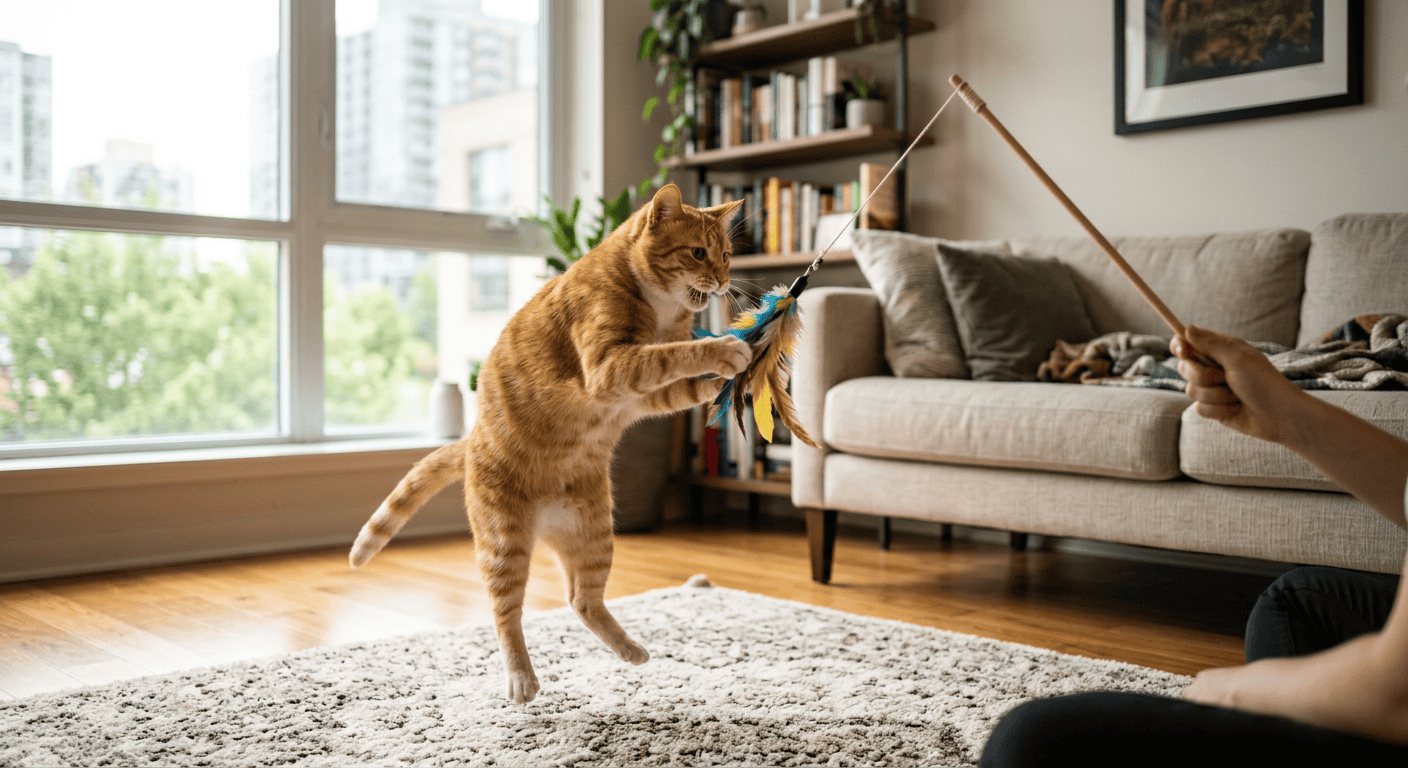
According to the Cornell Feline Health Center, indoor cats that lack prey-simulation play are significantly more likely to develop stress-related disorders including over-grooming (psychogenic alopecia), redirected aggression, and litter box avoidance. Wand toy play — where you control an erratic, prey-like movement pattern — is irreplaceable because it engages the cat’s full hunt sequence: stalk, chase, pounce, catch. Two 10–15 minute sessions per day (morning and evening) aligns with cats’ natural crepuscular activity peak.
In 2026, wand toy technology has evolved beyond basic feathers — options like motorized wand toys extend play sessions even when you’re busy. However, nothing fully replaces your direct participation: studies show cats engage more intensely and for longer when a human controls the toy versus automatic movement.
What About Window Bird Feeder?
Install a bird feeder outside a window your cat can watch from a perch. Bird activity provides hours of passive visual hunting stimulation daily — the cat equivalent of television. Suction-cup feeders work on most apartment windows without property modification. Pair with a window perch for comfort. This is the highest-value zero-effort enrichment available.
The ASPCA notes that environmental enrichment for indoor cats should engage all senses — visual stimulation from bird watching activates the same neural pathways as actual hunting without the risks of outdoor exposure. Positioning a bird feeder at a window your cat can comfortably access (with a perch, cat tree, or shelf) creates what veterinary behaviorists call a “cat television” station. Squirrel feeders work equally well for apartment windows where bird traffic is lower. Suction-cup window feeders require no drilling and are landlord-friendly.
What About Puzzle Feeders at Every Meal?
Replace the food bowl with a puzzle feeder that requires the cat to work for food. This converts twice-daily meals into foraging sessions — satisfying a primal drive that apartment life otherwise leaves unmet. Start with simple feeders (rolling balls, lick mats) and advance to complex puzzles as proficiency increases. See our budget cat enrichment guide for DIY options.

PetMD reports that cats in the wild spend 8–12 hours per day in hunting-related activity, yet most indoor cats consume their entire daily caloric intake in under 5 minutes from a static bowl. This massive under-stimulation of the food-seeking drive is one of the primary causes of feline obesity and boredom-related behaviors. Puzzle feeders extend mealtime to 15–30 minutes and provide the foraging experience cats are neurologically wired for. Start with easy puzzles and gradually increase difficulty as your cat’s problem-solving skills develop.
What About Vertical Territory?
A tall cat tree in front of a window is one of the most complete enrichment installations for an apartment cat — height (security), view (stimulation), and a dedicated perch (territory). Wall-mounted cat shelves add additional vertical territory without floor footprint.
In multi-cat households, vertical territory is critical for conflict reduction — cats establish social hierarchies by height, and a cat with nowhere to go “up” during tension will have no escape route, escalating stress. According to the American Association of Feline Practitioners (AAFP), apartments should provide at least one vertical space per cat plus one additional. Wall-mounted cat shelves are the most space-efficient option for small apartments and require only basic stud-finding and bracket installation — check with your landlord first or use tension-pole cat trees as a no-damage alternative.
What About Scatter Feeding?
Instead of placing food in a bowl, scatter dry kibble across a snuffle mat, across a flat surface, or hidden in multiple locations around the apartment. This turns eating into foraging and can occupy a cat for 10–20 minutes per meal. It’s free, zero-prep, and highly engaging.
Scatter feeding requires no equipment — simply throw kibble across a carpet or hide pieces under the edge of a blanket before mealtime. This activates nose-led foraging behavior that engages smell, hearing, and sight simultaneously. According to veterinary behaviorists, nose work is cognitively tiring for cats in the best possible way: a 10-minute scatter feeding session is equivalent to 30 minutes of passive activity for mental stimulation purposes. Particularly effective for cats that finish meals too quickly or show food-related anxiety.
What About Rotating Toy Library?
Store half your cat’s toys in a drawer and swap them every 7–10 days. Toys that have been out of circulation for a week register as novel to a cat’s habituation-resistant brain. This doubles your effective toy collection at zero cost.
Cats habituate rapidly to static stimuli — the same toy that triggered intense play on Monday may be completely ignored by Thursday. The AKC’s feline enrichment guidance (adapted from feline behavior research) recommends keeping only 2–3 toys accessible at any time and rotating the remainder weekly from a closed storage bin. The “out of sight” period restores novelty. This approach means you never need to buy another cat toy — a set of 8–10 toys on rotation stays fresh indefinitely.
What About Cat Grass?
A small pot of cat grass (wheat grass) on a sunny windowsill costs under $5 in seeds and grows in 7–10 days. Provides a safe chewing outlet that satisfies a foraging/plant-interaction need. Replace every 2–3 weeks as the grass dies back. See our pet-safe houseplants guide.
According to PetMD, cat grass (oat, wheat, or barley grass — distinct from catnip) serves multiple functions: it provides fiber that helps move hairballs through the digestive tract, satisfies the grass-eating instinct that outdoor cats express naturally, and gives indoor cats a safe plant to interact with. Growing cat grass from seed costs under $5 for a 90-day supply. Keep it in a low window or on a plant stand accessible to your cat. Replace every 2–3 weeks when it begins to wilt or mold.
8. Paper Bag and Box Exploration
Leave a paper grocery bag (handles removed for safety) or cardboard box on the floor. Most cats will investigate, enter, and play in it multiple times over 24–48 hours before losing interest. Rotate boxes from deliveries weekly for fresh novelty at zero cost.
Novel objects are a category of enrichment that apartment owners often overlook. New paper bags, boxes, or even a crumpled piece of newspaper placed on the floor gives cats something genuinely new to investigate — engaging smell, hearing (crinkling), and touch simultaneously. Cornell University’s feline behavior program notes that novelty-based enrichment is particularly important for preventing the “learned helplessness” state that under-stimulated cats develop, where they stop attempting to engage with their environment entirely. Rotate in a new object every few days for continuous low-cost enrichment.
9. Clicker Training Sessions
5-minute clicker training sessions — teaching sits, high fives, or targeting — provide significant cognitive engagement and strengthen the human-cat bond. Contrary to popular belief, cats respond very well to clicker training. Start with simple behaviors and build complexity over weeks.
Cats are highly trainable despite the cultural stereotype that they aren’t. According to the International Association of Animal Behavior Consultants, clicker training in cats reduces stress, builds confidence, and strengthens the human-cat bond through positive reinforcement. Even simple behaviors like sit, touch, and station (go to a specific mat) provide meaningful cognitive exercise. Five-minute training sessions 3–4 times per week using a basic clicker and high-value treats can produce noticeable behavioral improvements within 2–3 weeks.
10. Bird and Fish Videos
Play bird or fish videos on a tablet or laptop placed where the cat can view comfortably. Many cats respond strongly to authentic bird sounds and motion. Free on YouTube (search “cat TV birds for cats”). Not a substitute for interactive play but excellent supplemental enrichment during working hours.
For more enrichment ideas, see our 15 budget cat enrichment ideas, signs your cat needs more attention, and signs your cat is happy guides. The ASPCA’s cat enrichment guide and International Cat Care’s indoor cat guide are also excellent resources.
🛒 Related Picks on Amazon
📬 Free Weekly Apartment Pet Tips
Practical guides for apartment pet owners, delivered weekly.
The ASPCA recommends visual enrichment specifically for cats that show high predatory drive, as it provides a safe outlet for stalking and tracking behavior. Dedicated “cat TV” YouTube channels and streaming services now offer hours of high-definition wildlife footage specifically filmed at cat-eye level with sounds birds and small animals make. In 2026, several pet tech companies offer tablet mounts and interactive screens designed to respond to paw touches — turning passive watching into an active game. Best used in combination with wand toy play, not as a replacement.