
Frequently Asked Questions
What is an X-Pen and why is it recommended?
An X-Pen is a freestanding exercise pen that provides more space for your puppy while maintaining containment. It’s recommended for its flexibility in configuration and ease of storage in small apartments.
Are fabric playpens safe for puppies?
Yes, fabric playpens are safe for non-destructive puppies, offering a quieter alternative to metal pens. However, they may not be suitable for determined chewers.
How can I effectively use baby gates for puppy containment?
Baby gates can be used to limit a puppy’s access to certain rooms, allowing for more freedom while still preventing access to areas that may be unsafe.
What should I consider when choosing a safe room for my puppy?
Choose a small, puppy-proofed room with easy-to-clean flooring, and ensure that all chewable or toxic items are removed before leaving your puppy in that space.
Can crate alternatives help with puppy anxiety?
Yes, crate alternatives can reduce anxiety for some puppies by providing a more spacious and comforting environment compared to traditional crates.
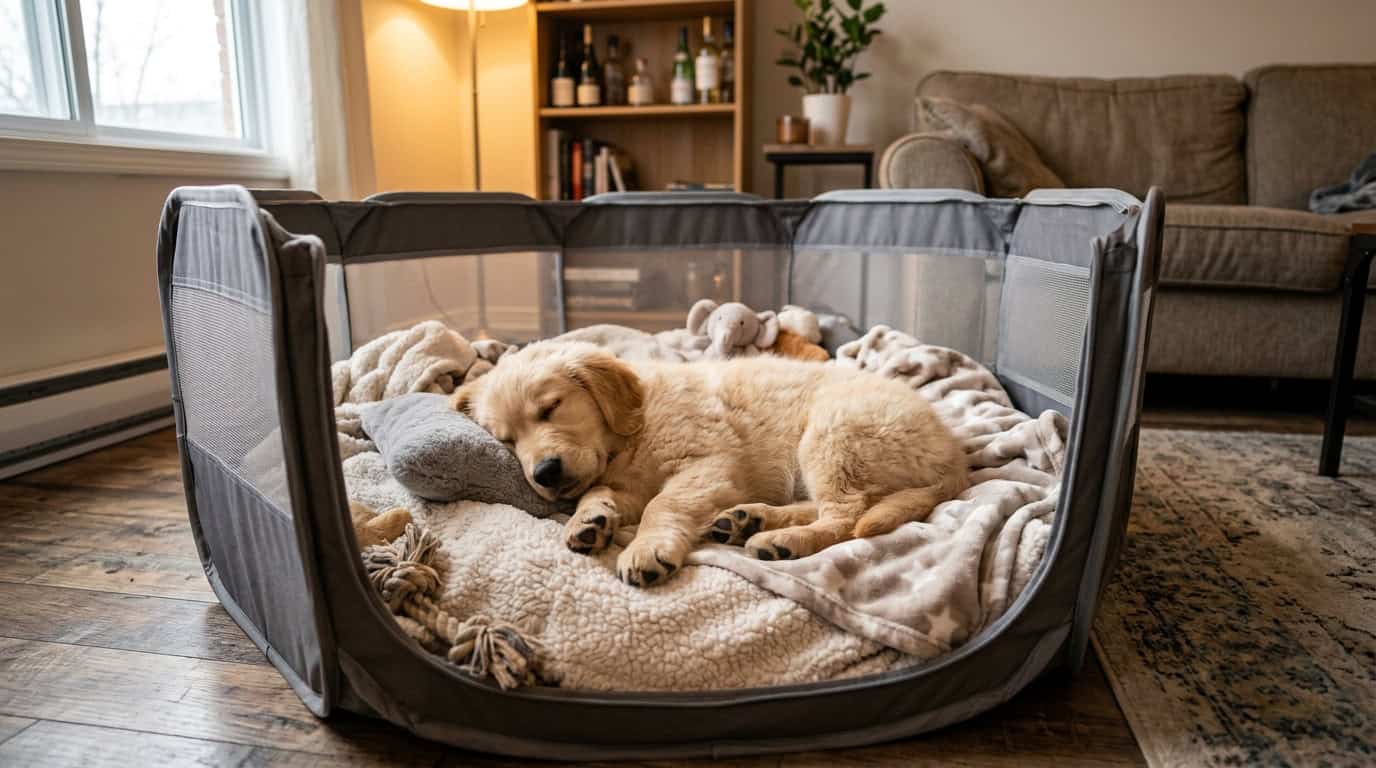
The best crate alternatives for puppies in apartments include exercise pens, playpens, baby-gated rooms, and soft-sided enclosures. These options give your puppy safe containment without the stress that some puppies experience in traditional wire crates — and they work perfectly in small living spaces.
Why Some Puppies Don’t Do Well with Traditional Crates?
Crate training is a popular and effective method — but it’s not universally the right choice for every puppy. Some puppies experience significant anxiety when confined to a small wire box, particularly those who’ve been separated from their littermates too early or who have anxious temperaments. For apartment dwellers, the noise of a distressed puppy is also a very real concern for neighbors.
According to the AKC’s puppy training guidance, the goal of early containment is to keep puppies safe and support housetraining — not to use a specific piece of equipment. That means crate alternatives are not just acceptable; they’re often preferable for certain puppies and living situations.
This guide covers 15 safe, practical crate alternatives for puppies, with specific tips for apartment use. For more apartment dog training strategies, see our complete guide to dog training in apartments.
What Are the Safe Crate Alternatives for Puppies in Apartments?
1. Freestanding Exercise Pen (X-Pen)
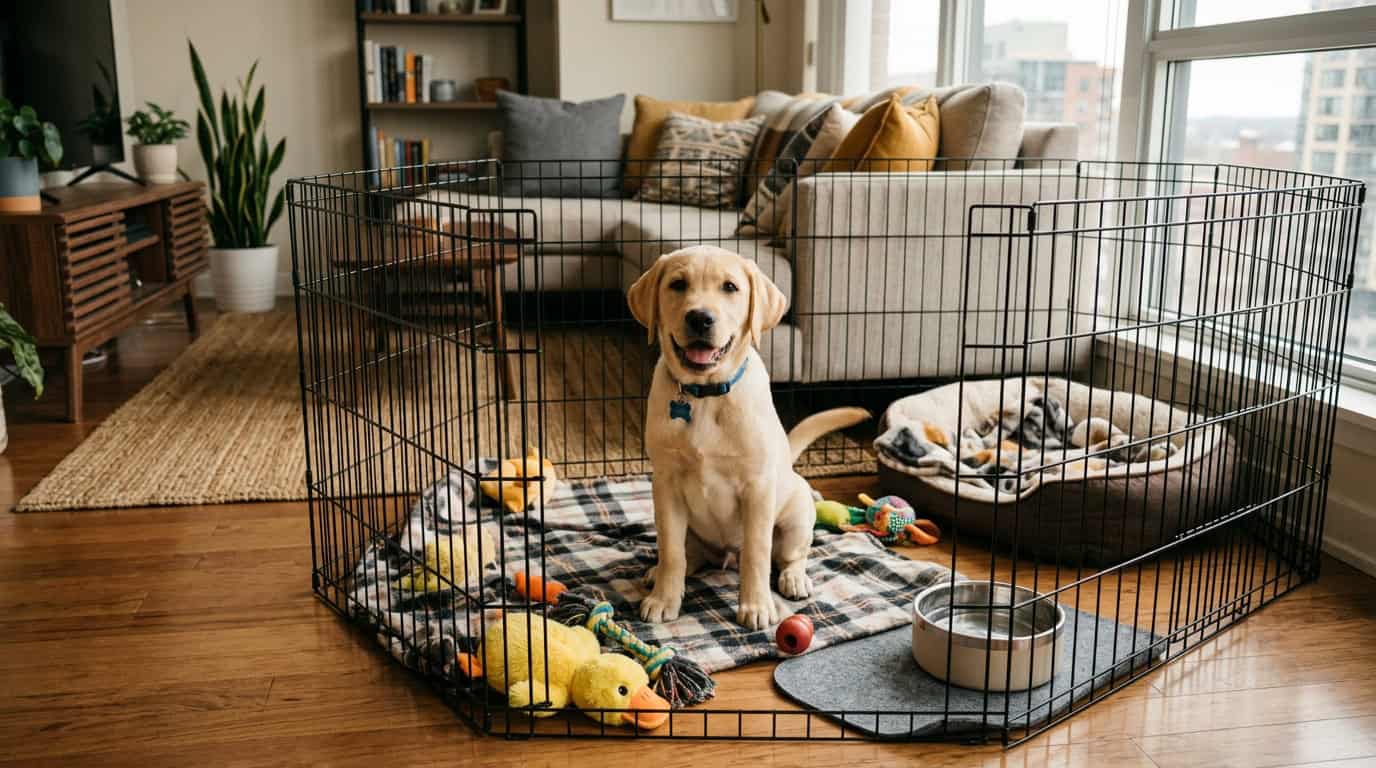
The number one crate alternative. An X-pen gives your puppy significantly more space than a crate while still maintaining containment. Most fold flat for storage (important in apartments), and they’re easy to reconfigure to fit your space. Look for pens at least 24 inches tall for small breeds, 36+ for medium breeds. Browse puppy exercise pens on Amazon — look for foldable, non-tip designs with a door for easy access.
2. Puppy Playpen
Similar to an X-pen but often softer-sided and designed more like a room divider. Fabric playpens are lighter and quieter (no metal clanging), but less durable for determined chewers. Ideal for non-destructive puppies in apartments where noise is a concern.
3. Baby-Gated Bathroom or Laundry Room
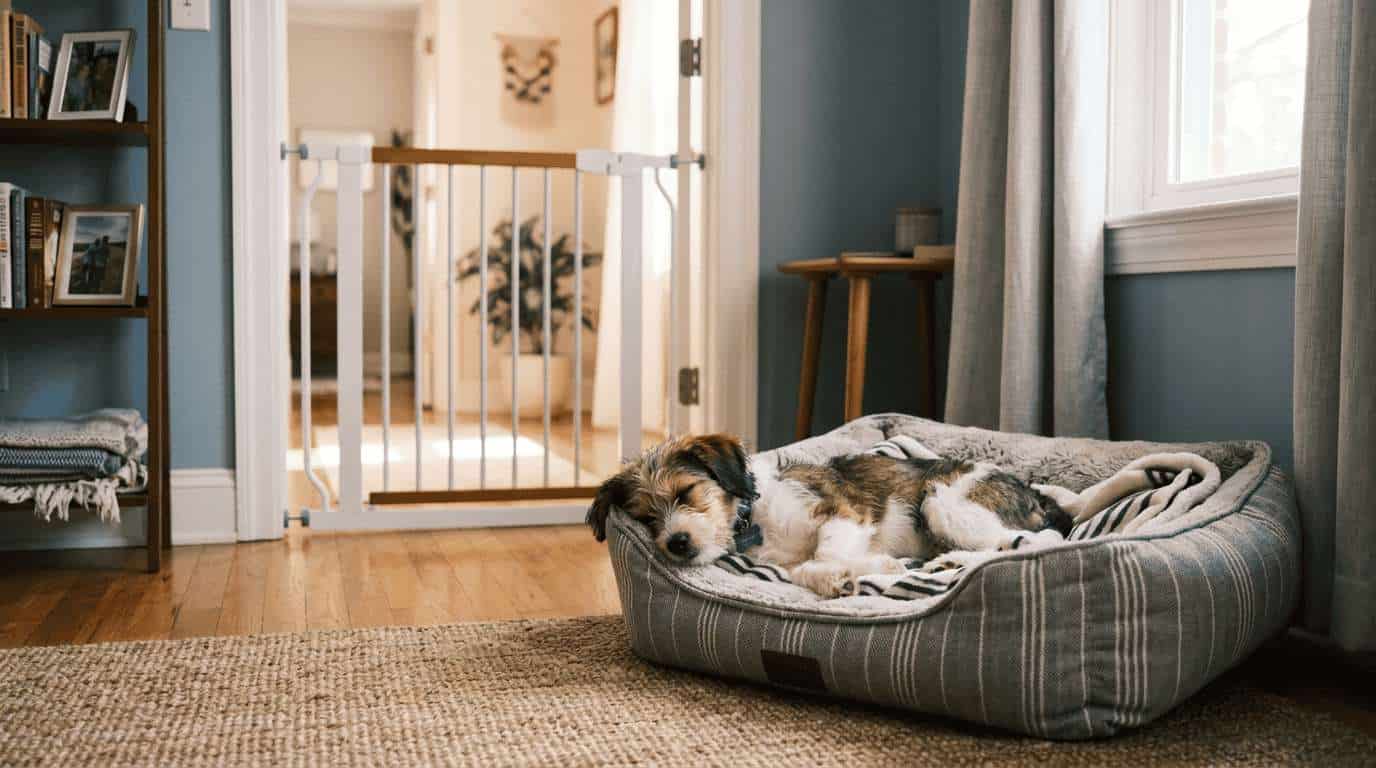
A small, puppy-proofed room with a baby gate across the doorway is one of the most space-efficient containment solutions. Bathrooms and laundry rooms typically have easy-to-clean flooring — a huge advantage during housetraining. Remove anything chewable or toxic before leaving your puppy in the space.
4. Baby Gates to Limit Room Access
Rather than confining your puppy to a single area, use baby gates to limit access to the entire apartment to one or two safe rooms. This gives the puppy more freedom while preventing access to dangerous or damageable areas. Find pressure-mount baby gates on Amazon — pressure-mount is ideal for renters since it doesn’t require drilling.
5. Soft-Sided Puppy Tent
Pop-up pet tents and soft enclosures are lightweight and fold completely flat — perfect for apartment storage. They work best for calm, non-destructive puppies and are ideal for nap time or short periods when you’re in the same room. Not recommended for puppies left completely unsupervised.
6. Dog Bed with Boundary Training
Some puppies can be trained to stay on a specific dog bed or mat using “place” training. This takes more time and consistency than physical containment but creates a puppy that has genuine impulse control. The ASPCA’s dog care resources offer excellent free guidance on positive reinforcement training methods suitable for puppies.
7. Modular Panel Enclosure
Heavy-duty modular panels (often sold as “puppy play yards”) can be configured in any shape and attached to walls or furniture in an apartment. They’re sturdier than fabric pens and can grow with your puppy. The downside is they take up more floor space.
8. Puppy-Proofed Bedroom
If your bedroom is free of hazards (cords, toxic plants, small objects), it can make an excellent puppy safe room. Many puppies are calmer in a space that smells like their owner. Use a baby gate on the door and remove anything you don’t want chewed.
9. Under-Desk Puppy Zone
For work-from-home apartment dwellers, setting up a dedicated puppy zone under or beside your desk is surprisingly effective. A washable dog bed, a chew toy, and proximity to you covers all the basics. Perfect for puppies who calm down when they can see their owner.
10. Travel Crate or Airline Carrier
If your puppy is small, a soft-sided airline carrier or travel crate can double as a sleeping area and safe space. Many puppies find these less threatening than wire crates because they’re enclosed on more sides, creating a den-like feel. Explore soft-sided puppy carriers on Amazon.
11. Puppy-Proofed Hallway
Many apartments have a hallway that can be gated at both ends, creating a safe corridor for your puppy. It’s not glamorous, but it’s effective and usually has easy-to-clean flooring. Add a bed and water bowl and it becomes a perfectly functional puppy space.
12. Foldable Pop-Up Play Yard
Pop-up play yards are designed for both human babies and pets — they fold flat in seconds and are particularly useful for apartment dwellers who need to reclaim floor space quickly. Many versions are waterproof on the base, making cleanup simple.
13. Combination Gate and Pen Setup
For medium-to-large puppies with high energy, combine a baby gate on a doorway with an X-pen inside the room to create a two-layer containment system. The puppy has access to a full room but can’t access the entire apartment. This works particularly well if you need longer-duration containment.
14. Daycare or Dog-Sitter
For puppies who are truly distressed by any form of containment, puppy daycare or a trusted dog-sitter is the most humane option. Many apartment areas have in-home dog care services, and the socialization benefits for puppies are significant. If your puppy shows signs of distress in all containment scenarios, read our guide on crate alternatives for dogs with separation anxiety.
15. Long-Term Confinement Area (LCA)
A Long-Term Confinement Area is a purpose-designed space for puppies who must be left alone for extended periods. It combines a bed, water, food, puppy pads, and safe toys in one gated-off zone — typically a bathroom or laundry room. Unlike a crate, an LCA acknowledges that puppies can’t hold their bladder all day and provides an appropriate outlet.
What Are Setting Up the Ideal Puppy Safe Space in an Apartment?
Regardless of which alternative you choose, every puppy safe space needs:
- A comfortable, washable bed: Puppies sleep 16–18 hours a day. Invest in a good washable dog bed. Find machine-washable puppy beds on Amazon.
- Fresh water: Always available. Use a non-tip bowl or a crate-mount bottle for X-pen setups.
- Safe chew toys: Puppies chew. Provide appropriate outlets to protect your apartment.
- Your scent: A worn t-shirt or pillowcase in the safe space significantly reduces puppy anxiety.
- Puppy pads: For puppies not yet fully housetrained. Position them far from the sleeping area.
What Are Recognizing Puppy Boredom vs. Distress?
It’s important to distinguish between a puppy who is adjusting to their safe space (expected whining for 10–15 minutes) and a puppy in genuine distress. Our guide on 15 signs your dog is bored in an apartment covers the behavioral signals to watch for. For nighttime issues specifically, see our guide on 15 ways to calm dog anxiety at night.
According to VCA Hospitals’ crate training guide, puppies should never be left in any form of containment for longer than developmentally appropriate, and any containment should be associated with positive experiences like meals and treats.
When to Try Other Approaches?
If your puppy continues to struggle with containment of any kind, consider consulting a certified professional dog trainer. The PetMD behavior resource center has excellent guides on recognizing separation anxiety and finding qualified help. Also revisit our 8 crate alternatives for small apartments for a focused comparison of the most space-efficient options.