
15 Clever Cat Apartment Hacks That Actually Work in Small Spaces
Living with a cat in an apartment doesn’t mean sacrificing your space or your sanity. The truth is, cats don’t need square footage — they need vertical territory, mental stimulation, and a few clever setups that work with your floor plan, not against it.
Whether you’re in a 400-square-foot studio or a two-bedroom with a roommate, these 15 cat apartment hacks are designed for real apartment life: renter-friendly, budget-conscious, and actually effective. According to the Humane Society, indoor cats live significantly longer than outdoor cats — but only when their environment actively meets their behavioral needs. These hacks do exactly that.
Why Standard Apartment Setups Fail Cats?
Most apartment cat setups look the same: litter box in the bathroom corner, food bowl on the floor, maybe a cat tree that tips over whenever the cat looks at it sideways. That’s not an enriched environment — it’s a storage problem with fur.
Cats are territorial, vertical, and stimulus-seeking animals. When those needs go unmet, you get stress behaviors like excessive meowing, furniture scratching, and midnight zoomies. The hacks below address root causes, not just symptoms.
What Are The 15 Best Cat Apartment Hacks?
Go Vertical with Wall-Mounted Cat Shelves
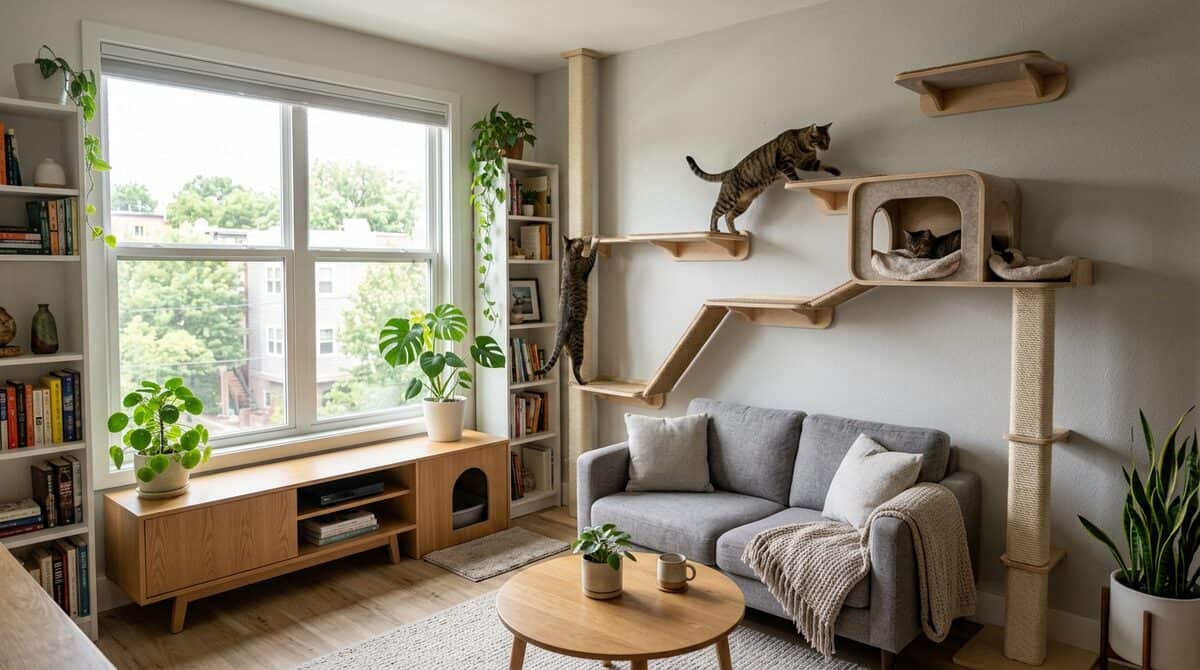
Floor space is precious in apartments. Vertical space is almost always wasted. Install a series of wall-mounted cat shelves at different heights to create a “cat highway” your cat can patrol all day. Use 2–3 shelves staggered at 12-inch intervals so your cat can climb safely. Anchor into studs, not just drywall, and add carpet or sisal pad covers for grip. This hack gives your cat 8–12 feet of new territory without taking a single square inch of floor space.
Product to look for: Wall-mounted cat shelves on Amazon →
Hide the Litter Box Inside Furniture
The litter box is the elephant in the room — or rather, the eyesore in the bathroom. Furniture-style litter box enclosures look like side tables or storage benches and completely disguise what’s inside. Top-entry versions dramatically reduce litter scatter and keep odors better contained. Your guests won’t know it’s there. Your cat won’t care either way.
Product to look for: Furniture litter box enclosures on Amazon →
Create a Dedicated Window Perch
A window is a cat’s television. A window perch — whether a mounted bracket shelf or a suction-cup hammock — gives your cat hours of stimulation watching birds, people, and weather. Research cited by International Cat Care confirms that environmental enrichment including visual access to the outdoors significantly reduces stress in indoor cats. Position it where afternoon sun hits for maximum appeal.
Use a Tall, Heavy-Base Cat Tree — Not a Wobbly Toy
The cheap wobbly cat tree from a big box store is one of the most common cat apartment mistakes. If it tips when a 10-pound cat jumps, the cat learns not to trust it — and goes back to your couch. Invest in a cat tree that’s at least 5 feet tall with a heavy base and sisal-wrapped posts. Your couch will thank you.
Place Scratching Posts Strategically, Not Randomly
Cats scratch to mark territory and stretch — both instinctive behaviors. The hack isn’t just having a scratching post; it’s placement. Put one post right next to the furniture your cat currently scratches, and another near their sleeping area (cats scratch after napping). Redirect consistently. Within 2–3 weeks, the furniture becomes boring. For more strategies, see our guide on stopping cat scratching furniture.
Use a HEPA Air Purifier with Carbon Filter
Cat dander and litter dust are the two biggest indoor air quality problems for apartment cat owners. A quality air purifier with both HEPA filtration (for dander particles) and activated carbon (for odors) makes a noticeable difference within 24 hours. Run it in the room where your cat spends the most time. Also helps with allergies if you have guests who react to cats.
Product to look for: Pet air purifiers on Amazon →
Install a Sliding Latch on Cabinet Doors
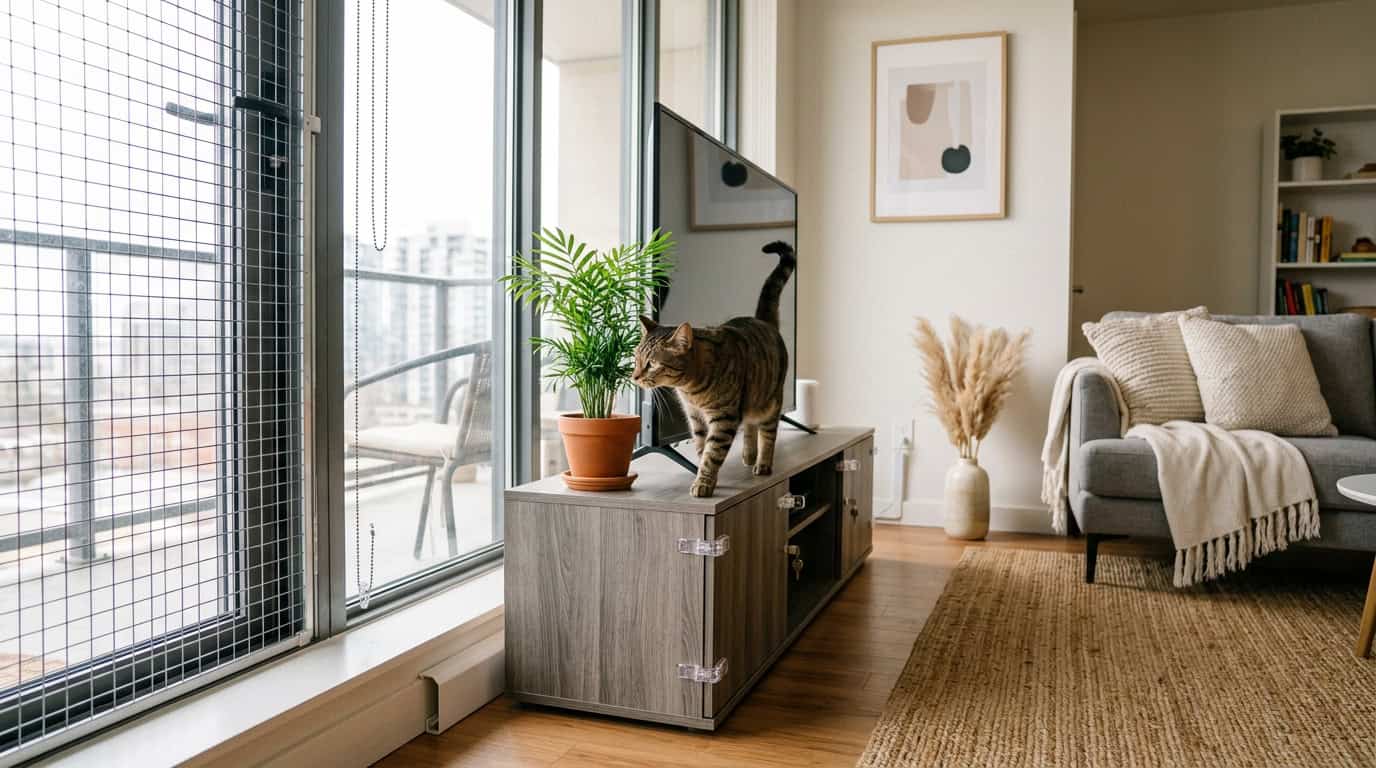
Cats are relentless problem-solvers. If there’s a cabinet with something interesting (cleaning supplies, food, a warm dark space), your cat will figure out how to open it. Child-proof sliding cabinet latches from any hardware store install in minutes, require no drilling, and prevent your cat from accessing dangerous chemicals or getting trapped inside. Worth doing proactively before the first incident.
Feed via Puzzle Feeders Instead of Bowls
Free-feeding from a bowl contributes to obesity and boredom in equal measure. Puzzle feeders (also called slow feeders or food puzzles) make your cat work for their food, mimicking hunting behavior and providing 10–15 minutes of mental stimulation at every meal. This single swap reduces boredom-related behaviors like signs of boredom more effectively than most toys. Start with a simple level-1 puzzle and work up.
Product to look for: Cat puzzle feeders on Amazon →
Rotate Toys Every 3–4 Days
Cats habituate to toys quickly — the same feather wand that drove them wild on Monday becomes invisible by Thursday. Keep a basket of toys and rotate 3–4 into active rotation every few days, “resting” the others. When a toy reappears after a week off, it’s novel again. This trick costs nothing extra and dramatically extends the life of your toy collection while keeping your cat engaged.
Create a Cozy Cat Corner with Thermal Blankets
Cats seek warmth and security. Dedicate one corner — under a desk, beside the couch, in a closet — to your cat with a thermal self-warming blanket, a covered bed, and maybe a worn t-shirt for your scent. This gives your cat a “home base” where they feel safe. Cats with secure home bases are measurably less anxious, according to behavioral research from the Cornell Feline Health Center.

Use Double-Sided Tape on Off-Limits Surfaces
Cats hate sticky surfaces on their paws. A strip of double-sided tape on the edge of the kitchen counter, the corner of your couch, or the top of the bookshelf deters most cats within 2–3 exposures — no punishment needed. Remove after 2–3 weeks; the cat has usually formed a new habit by then. Pair with a permitted surface nearby (like a cat tree or perch) so they have an alternative. Also useful for keeping cats off counters.
Run Daily 10-Minute Interactive Play Sessions
Ten minutes of active play with a wand toy or laser pointer — morning and evening — satisfies your cat’s hunting drive, burns energy, and strengthens your bond. Per PetMD’s behavioral experts, scheduled play is the single highest-return investment an indoor cat owner can make. Schedule it like a meeting. Your cat will start anticipating it and be calmer the rest of the day.
Use a Water Fountain Instead of a Still Bowl
Cats evolved from desert animals and have low thirst drives. Many cats don’t drink enough from a still bowl, leading to urinary tract issues — a major vet expense. A recirculating cat water fountain with a filter encourages drinking by mimicking a running stream. Most cats drink 30–50% more water with a fountain. Setup takes 10 minutes and costs less than one vet visit for a UTI.
Install a Window Bird Feeder Outside
If you have window access, a suction-cup bird feeder on the outside of your window turns it into a live wildlife channel for your cat. Finches, sparrows, and even squirrels stop by regularly, giving your cat hours of focused enrichment. It costs under $20 and requires zero floor space. Pair with a window perch directly below for maximum effect.
Cover Exposed Cords with Spiral Cable Wrap
Electrical cords are both a chewing hazard and a cat magnet. Spiral cable wrap (available at any hardware store) bundles exposed cords and makes them much less appealing to chew. For cords that can’t be bundled, use cord covers that adhere to baseboards. Check out iCatCare’s behavior guidance for understanding why cats target cords and other household items.
What Should You Know About Putting It All Together?
Overwhelmed? Start with just three: a wall shelf above the couch, a furniture-style litter box enclosure, and a window perch. These address territory, hygiene, and stimulation — the core triangle of apartment cat welfare. Add one more hack per week and within a month you’ll have a genuinely enriched space.
If you’re watching for signs your cat is thriving with these changes, read our guide on signs your cat is happy in an apartment.
Frequently Asked Questions
Maximize vertical space with cat shelves and trees, rotate toys regularly, provide window access, and schedule daily interactive play sessions. Mental stimulation is just as important as physical space.
A top-entry litter box hidden inside a piece of furniture (like a bench or cabinet) keeps odors contained and saves floor space. Place it in a low-traffic area with good ventilation and scoop daily.
Place scratching posts next to furniture your cat currently targets, use double-sided tape as a temporary deterrent, and reward your cat every time it uses the post. Tall, stable sisal posts work best.
Yes, when properly anchored into wall studs using appropriate hardware. Always follow weight ratings and check shelves monthly for any looseness or wobble.
Scoop the litter box daily, use a clumping or crystal litter with activated charcoal, run an air purifier with a HEPA and carbon filter, and launder fabric surfaces weekly. A furniture-style litter enclosure makes the biggest single difference.